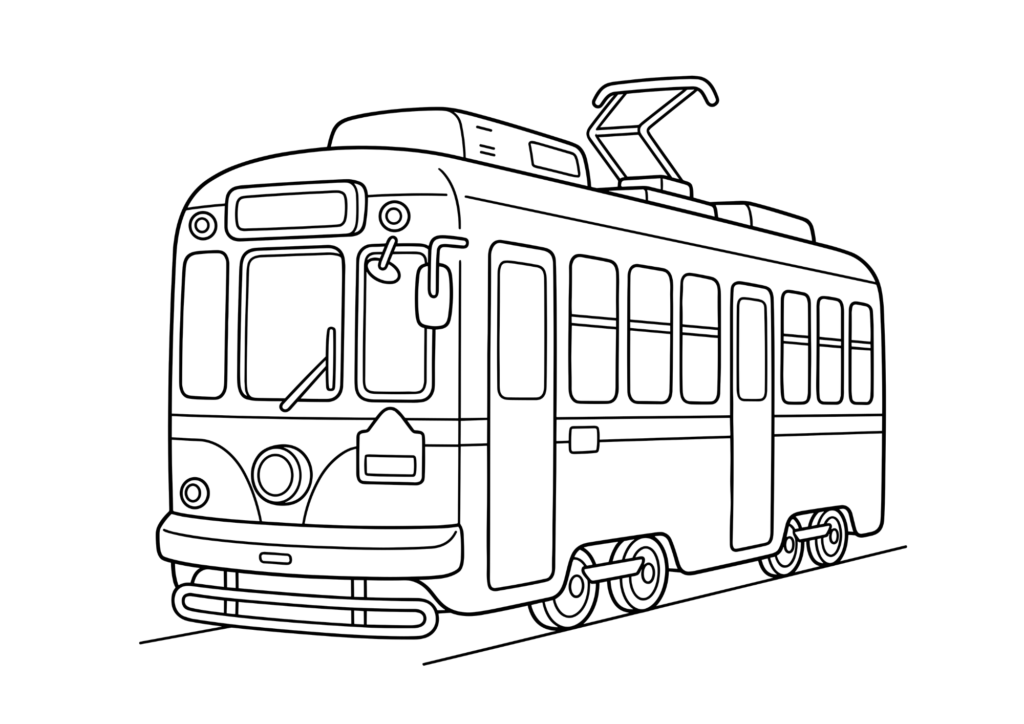
A coloring page of a streetcar running through a Showa-era Japanese town. With the clang of its bell, the streetcar rolled slowly past shopping streets and houses. Streetcars once ran in cities all over Japan, and this page lets you enjoy that nostalgic ride again in color.
🗣 Conversation Starters — for care activities and family time
“Have you ever ridden a streetcar? Where was it?”
“Do you remember the ding-ding of the streetcar bell?”
“How did you get to school when you were a child?”
Why are streetcars called “chin-chin densha” in Japan?
The nickname comes from the bell the conductor rang to signal the driver. Two rings (“chin-chin”) meant “all clear, ready to go,” and a single ring meant “stop.” The friendly sound stuck, and “chin-chin densha” (the ding-ding train) became an affectionate name for streetcars.
Which Japanese cities still have streetcars?
About 20 cities still run streetcars today, including Sapporo, Hakodate, Toyama, Toyohashi, Tokyo (the Toden Arakawa Line), Kyoto (Randen), Osaka (Hankai Line), Okayama, Hiroshima, Matsuyama, Kochi, Nagasaki, Kumamoto and Kagoshima. Modern low-floor light rail (LRT) cars and new lines, such as the one that opened in Utsunomiya in 2023, have brought renewed attention to streetcars as an eco-friendly way to get around.
Why did so many cities get rid of their streetcars?
During Japan’s period of rapid economic growth, from the mid-1950s to the early 1970s, car ownership rose quickly and traffic jams became serious. Streetcars sharing the road were blamed for the congestion, and many cities closed their lines. In Tokyo, the city-run network was cut back by 1972 to a single route, today’s Toden Arakawa Line.