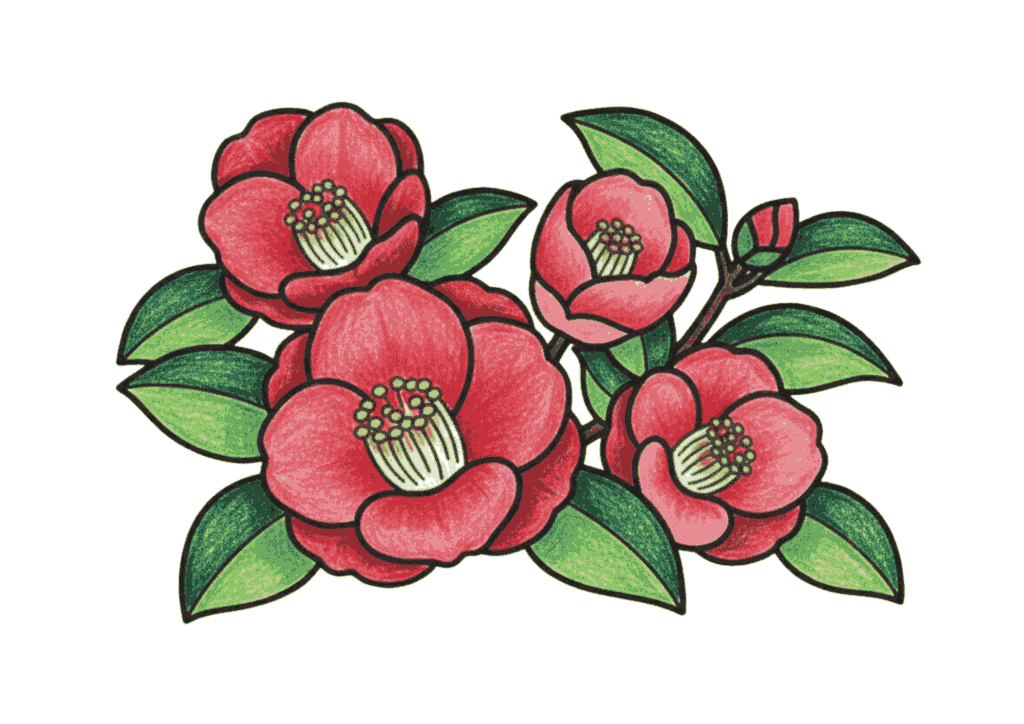
A coloring page of camellias — tsubaki, the flower of the Japanese winter. This is a free printable for adults and seniors: three open blooms, a tight round bud and thick, glossy leaves overlap across the page, so you can take your time separating one layer from the next. Download the PDF and print it at home — no registration required.
Ideal love, modest virtue and unaffected grace (red); perfect beauty and faultless charm (white)
Blooming season
December to April (varies by cultivar)
Great for
Adults and seniors (care activities)
Category
Flowers and Plants, For Seniors & Care, March
File format
PDF (line art) and PNG (line art and color sample)
🗣 Conversation Starters — for care activities and family time
Have you seen camellias in flower between winter and spring?
Have you ever used camellia oil on your hair or skin?
Have you seen a camellia used as the flower at a tea ceremony or a tea lesson?
Did you ever grow camellia or sasanqua in your own garden?
Why is the camellia said to have been unlucky for samurai?
A camellia does not shed its petals one by one: the whole flower head drops at once. A widely repeated story says that Edo-period samurai read this as an omen of a head falling and thought the flower unlucky — though how far that belief really went is hard to pin down. In the world of the tea ceremony the opposite is true. The camellia has been prized since the time of Sen no Rikyu as the flower that best embodies wabi-sabi, and it remains the classic chabana, the flower arranged for tea.
Is the Japanese camellia known outside Japan?
Yes. Japan’s wild camellia, yabu-tsubaki (Camellia japonica), reached Europe in the seventeenth century, where breeders took it up enthusiastically and produced hundreds of garden forms. Coco Chanel is said to have loved the flower, and the camellia went on to become an emblem of the fashion house she founded.
Is it true that oil is pressed from camellia seeds?
Yes. Tsubaki abura — camellia oil — is pressed from the seeds and has been used in Japan for generations to care for hair and skin. It is rich in oleic acid, and the island of Izu Oshima is particularly well known for producing it.