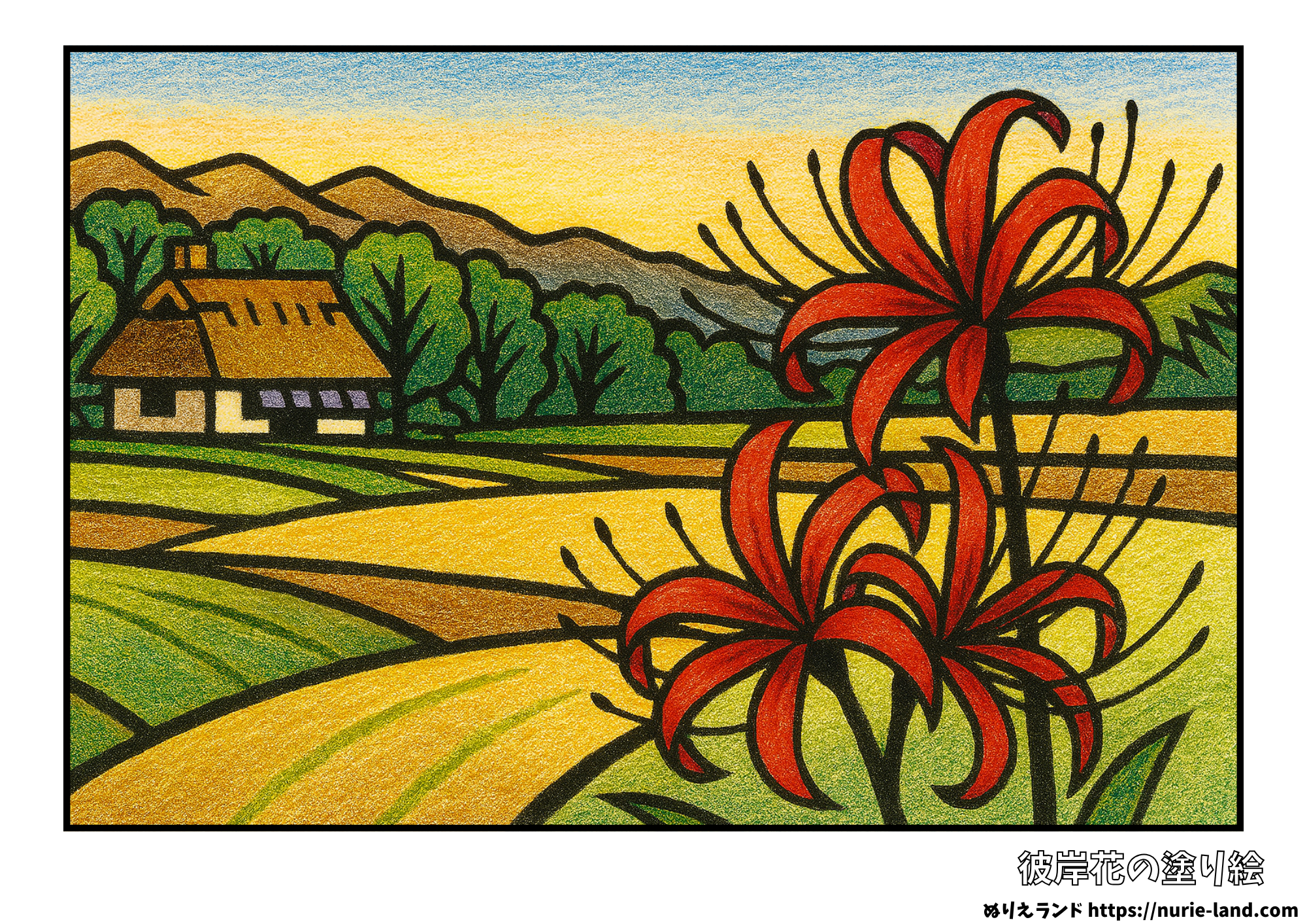
A free coloring page of the Japanese countryside in autumn — red spider lilies standing along the path, terraced rice fields sweeping toward the hills, and a farmhouse among the trees. It is designed for adults, seniors and care activities: the long field lines are easy to fill, while the slender petals reward a careful hand. Download and print the PDF for free, no registration required.
🗣 Conversation Starters — for care activities and family time
Is there an autumn scene — the leaves turning, or the rice harvest — that has stayed with you?
What do you remember about autumn in the countryside when you were a child?
Have you ever gone out to view the autumn leaves? Which place made the strongest impression?
Which autumn foods do you like best — chestnuts, sweet potatoes, mushrooms, or the year’s new rice?
Why are Japan’s autumn colors so celebrated?
The usual explanation is the climate: sharp differences between day and night temperatures, plus enough moisture, bring the leaves to vivid reds, oranges and yellows. Maple, ginkgo and sumac are among the best-known trees for it, and momijigari — going out to view the autumn leaves — is said to date back to the aristocracy of the Heian period.
What does a satoyama — a village at the foot of the hills — look like in autumn?
In autumn you see hazakake — cut rice hung on wooden racks to dry — along with persimmons, chestnuts and ginkgo nuts ripening, and the trees turning color. For many older people this was simply the everyday view from the farm, which is what makes the scene such a warm memory.
When does the rice harvest take place?
It varies by variety and region, but generally from late August through October. It was once heavy work — cutting the rice by hand, bundling it, and hanging it to dry — while today a combine harvester does almost all of it in one pass.