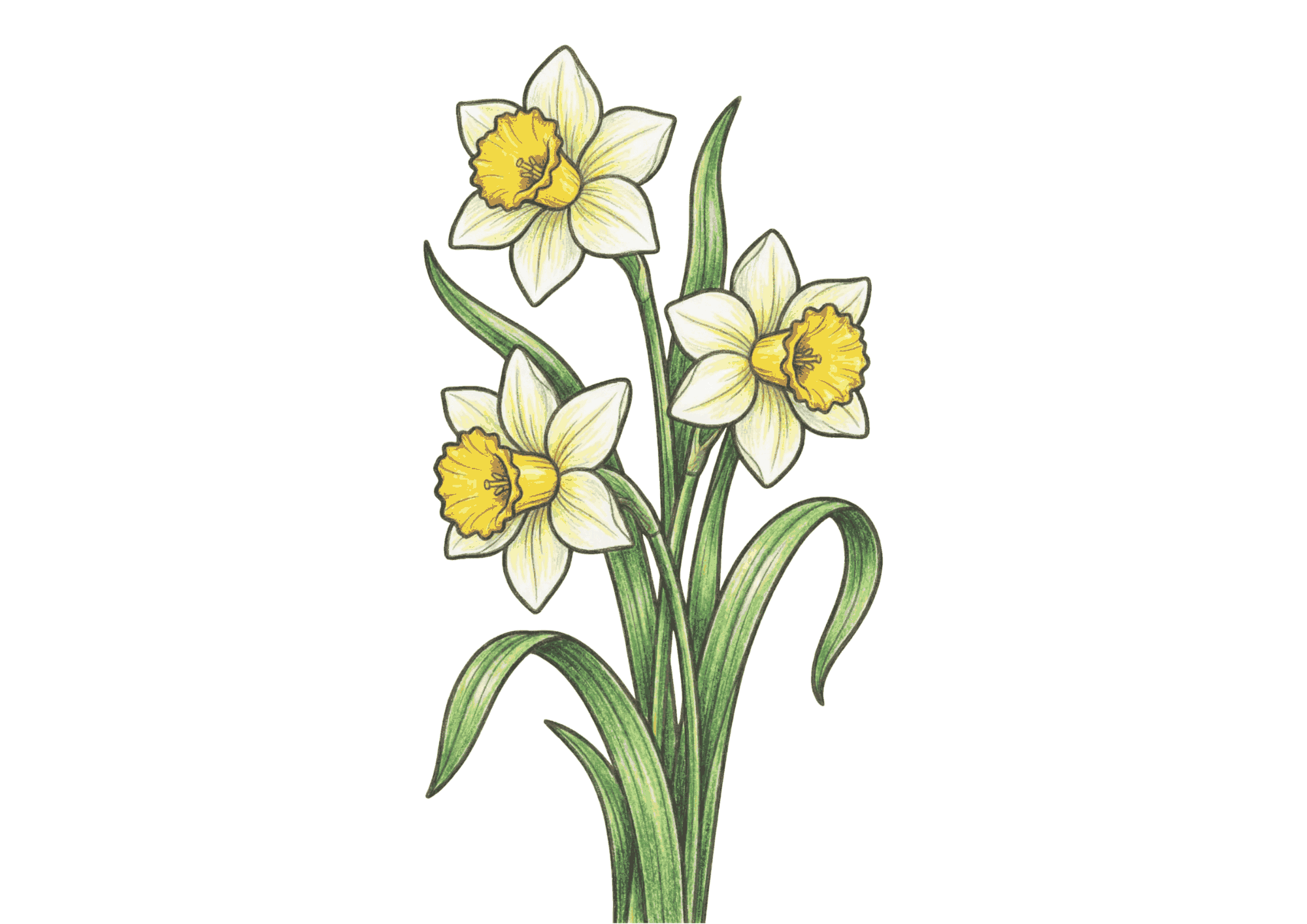
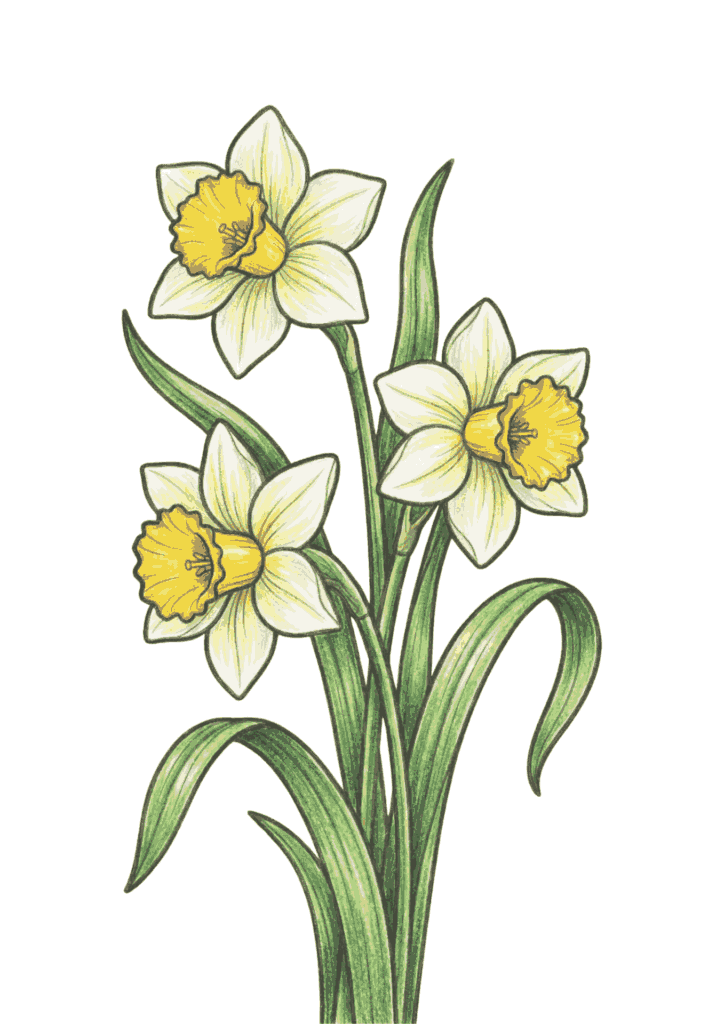
An easy daffodil coloring page. This is a free printable for seniors and care settings: the outlines are bold and the shapes are kept simple, so the six spreading petals, the trumpet-shaped cup at the centre of each flower and the long strap-like leaves can be filled in comfortably without close work. Download the PDF and print it — no registration required.
🎨 Easy Daffodil Coloring Page — Color Sample
🖊 Easy Daffodil Coloring Page — the printable line art is inside the PDF
🗣 Conversation Starters — for care activities and family time
Have you seen narcissus in flower between winter and spring?
Have you ever visited a place famous for narcissus, such as the Echizen coast or the town of Kyonan?
Which of the winter-flowering plants is your favourite?
Do you have memories of growing bulbs in a garden or a planter?
Where do the names suisen and narcissus come from?
The Japanese name suisen comes from Chinese and means something like “water hermit”. The plant grows happily both in well-drained ground and near water, and its upright bearing in the snow was likened to a hermit-sage. The English name narcissus comes from the beautiful youth of Greek myth.
What kinds of narcissus are there?
There are a great many: the Japanese narcissus (nihon-suisen), trumpet daffodils, double-flowered forms and bunch-flowered tazetta types among them. Two of the best-known places to see Japanese narcissus growing in drifts are the Echizen coast in Fukui Prefecture and the town of Kyonan in Chiba Prefecture, where the slopes turn white in midwinter.
Is it true that narcissus is poisonous?
Yes. The bulbs and leaves contain lycorine and other toxic compounds. Cases of accidental poisoning happen because the leaves can be mistaken for Chinese chives (nira). Narcissus leaves are stiffer than chives, and the bulb has none of the onion-like smell — but the safest rule is simply not to grow the two side by side.